Menu

The financial success of any entity is tied to two key budgeting figures: projected values and actual values. When looking ahead at an upcoming fiscal period, an educated guess is made on how much money will be received and spent. When looking back, the actuals are tallied. At that point a detailed analysis can be made to determine why, exactly, we never come close to predicting the future.

Need an example? While the following is not of a fiduciary nature, it’s still a good illustration of the elements of budgeting. My projections and actuals for 2018:

Projected
Actual
January

Ahhh! The new year! A clean slate! Endless possibilities! I shall kick things off by creating an ambitious to-do list. Some of my 2018 goals: promote my recently-published memoir, finally finish moving into the “new” house, clean up the junk room, organize the garage, complete the landscaping and exterior projects, finish a solid draft of a novel, compose and record a new album of music, and lose forty pounds.

And by “2018 goals” I don’t mean “my goals for 2018.” I literally mean “the two thousand and eighteen things I want to get done this year.”

First order of business in all that? Finally get my home recording studio set up again.

I got tasked with a big project at work last year. By the start of 2018, I’d already been working on it for several months, but by January 31, things were really moving into high gear. And if that weren’t enough, I also got knocked down with the flu for more than a week. No progress on the goals yet.
February
Maybe set up that recording studio. Or dust off one of those manuscripts-in-progress. I didn’t get as much done in January as I would’ve liked, but that’s okay. Most of the year is still ahead of me. Still worked on that big project pretty much the entire month. Sadly, it’s now extended into longer hours each day as well as taking up weekends.
March
The weather in Texas is getting better. It’s probably time to work on that landscaping. We got nearly halfway done in 2017, but the year ran out on us before we could complete the whole task. Good news on the work front! This project should be done pretty soon. Then I can get back to focusing on myself.
April
Well, the project isn’t wrapping up the way I’d hoped. So I’ll probably still be working a lot this month. Worked a lot this month.
May, June, July
I’ll probably still be working a lot this month. Worked a lot this month.
August
Wrap up that big project by the end of the first week. (Really!) Then start catching up on things. Pick a few items off the list and take care of them. It happened. It finally happened. At last that ginormous, all-consuming, work task is behind me. Everything else fell by the wayside this year. But when the burden lifted, I honestly didn’t know what to do with myself. Where do I start? August flew right by and apart from catching up on some bills and reintroducing myself to those people I live with, nothing happened.
September
Resurrect the blog, get back to Scribophile, and, hey, maybe start setting up that home recording studio again. Huh, weird. I actually did everything I said I would. The studio is nowhere ready to go, but I did “start” as planned.
October
Wow, since things kind of started going my way last month, let’s shoot for the stars in October. Before Halloween, I will promote my recently-published memoir, finally finish moving into the “new” house, clean up the junk room, organize the garage, complete the landscaping and exterior projects, finish a solid draft of a novel, compose and record a new album of music, and lose forty pounds. I don’t know where the month went.
November
It’s November already! NaNoWriMo has rolled around once again. This month I shall dust off my old “Ronald” manuscript from 2013 and give it a fresh go. My schedule seems pretty clear and I can finally buckle down and focus on one of my bigger 2018 goals: finish a solid draft of a novel Completed about eight percent of my manuscript. In spite of the month looking like it would be clear and free, I got sidetracked by work, family, and traveling (both business and pleasure). But, at least I have a better start than before. I may still be able to turn this into something.
December
Prepare for Christmas. Christmas.
 

And just like that, another year is over. I’m consistent, if nothing else. (And, at this point, it honestly does feel like I’m nothing else.)

I’m heading into the upcoming year with the usual deflated, semi-depressed feelings. I did some serious introspection this year, and I guess time will tell if that changes anything in 2019. But if I can be perfectly honest, I’m getting rather tired of making plans that never materialize. What’s that quote again? The one about trying the same thing over and over and expecting different results?

Although . . . Hmmm . . .

You know . . . technically-speaking there are three whole days left in 2018, so I really can’t say the year is over yet. While every day feels like a blink, the reality is we can get a lot done in twenty-four hours. So why not whip up a few goals for the last three days!? That should be plenty of time to promote my recently-published memoir, finally finish moving into the “new” house, clean up the junk room, organize the garage, complete the landscaping and exterior projects, finish a solid draft of a novel, compose and record a new album of music, and lose forty pounds.

Let’s do this!!!
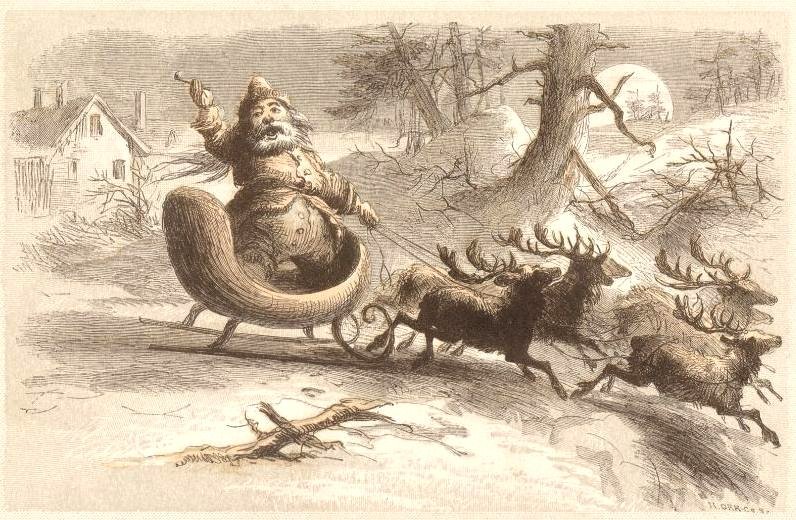
’Twas two months ere Christmas, I hopped in my car.
I turned the right key and the engine did start.
The lights they did light, but then as if planned:
I heard the tradition I think should be banned.

I grumbled and groaned, put the car into gear.
And drove to the mall, with no hint of cheer.
I walked in the store, and from overhead:
The sound of the season I perfectly dread.

My feet turned and left, my errand unfinished,
My hands on my ears, my spirit diminished.
So off to a bar, to drown my one sorrow,
Hoping and praying: a better tomorrow?

But even this place, it gave me no rest.
In this haven of drink, I still felt much stress.
For blasting out of that big old jukebox
The musical strains bearing down like an ox:

Mariah was singing that same Christmas song!
The thousandth time over and still going strong.
Then right after that (as if right on cue)
Elvis did croon on his Christmas of Blue.

I drank and I sobbed. And I drank and I frowned.
In no sum of beer could this music be drowned.
More rapid than eagles, the tunes! oh they came.
I grimaced and shouted and called them by name!

On Mathis! On Williams! On Crosby and Wham!
On Autry! On Buble! It goes on, this sham…
It’s Band-Aid and Eartha and Chuck Berry too.
By Lennon and Ono, I feel like I’m through.

A song here and there can sometimes be nice.
But twenty-four-seven? Just put me on ice.
At least it ends soon, this annual pain . . .
Then ten months of bliss ere it starts up again.

When NaNoWriMo began, back in 1999, it took place in July. Part of me still wishes it did. You see, July offers three distinct advantages over November:

  1. July has thirty-one days, not thirty.
  2. July is free from a four day, family-oriented Thanksgiving weekend.
  3. July provides five additional months to finish your New Years resolution instead of just one.

So you see, writing a novel in a single month is hard enough without the shortened schedule that November brings.

Kickoff

This year I decided to pick up a manuscript I began in 2013. Apart from a brief-but-pointless bit of editing in 2016, I haven’t even thought about it for five years. Strictly speaking, NaNoWriMo should be about a wholly new project, but it’s not unusual for participants to dust off an old project and give it another go.

And I have some good news on that November-is-too-short issue. There actually is a way to turn November into a thirty-one day month. As with prior years, I kicked off NaNo at Dragon’s Lair late Halloween evening. And at the stroke of midnight, one hundred or more writing enthusiasts and I set fingers to keyboards (or, as a few traditionalists do, pens to paper) and began our creations.

And that’s how we add an extra day to a short month. Although it’s technically November, it still feels like October and many of us complete our full day’s word count in those first two hours. We then go home, sleep, wake up, go to our jobs, and then that evening begin our “second” day of writing.

Chapter One

“It was the best of times, it was the worst of times.”

“You don’t know about me without you read a book by the name of Tom Sawyer.”

“Call me Ishmael”

The opening line is important. But NaNo’s quantity-over-quality pace doesn’t always lend itself to perfect prose. Still, the book has to open somehow and I didn’t want to reuse my 2013 opening, so I had to come up with something new.

“It was a dark and stormy night.”

Ah yes, my favorite opening. I didn’t use these exact words, of course, but I prefer the dark and I prefer the rain so it really is the best combination. Except that “a dark and stormy night” didn’t actually fit the plot. So at five minutes past midnight I found myself stuck.

Chapter One, Still

A couple days later — the first weekend in November — something came up and I didn’t make much progress. Then there was a business trip. Then a long weekend out of town. Then more work. I tried to poke at the manuscript at least a few minutes each day, but halfway through the month I was still hammering away at Chapter One.

Nothing was coming together. Every new paragraph invalidated the previous. It wasn’t the first time I’d gotten stuck — not by a long shot — but it was the first time I started to seriously reconsider this whole writing thing. Like, really reconsider. Like, what is the point in trying this again and again and never ever getting anywhere? As Albus Dumbledore said in The Empire Strikes Back, “The definition of insanity is trying to write the same book over and over and expecting different results.”

Word Count

The good news is, I didn’t give up and I managed to push past the first chapter. I made it up to and through the plot’s inciting incident. But to say I was taking things slow is an understatement. Back in 2014, I hit my fifty-thousand word goal in ten days. While I’m not good with the maths, I do know that’s more than two hundred words per day, which is about all I averaged this month.

BUT . . . I think I’m onto something. In spite of only getting some ten percent done, I feel like I have a decent start. In fact, this gives me a real fighting advantage when I give this manuscript another go in November 2023.

The real sad part? I gave up blogging for the month for that. I feel bad, so to make up for it, please enjoy this beautiful rendition of Silent Night:

That is me playing the violin, Biz playing flute, and Laura playing the guitar. We recorded that in 1989 to be the outgoing message on my answering machine. It’s now a family Christmas classic.

We interrupt our regularly scheduled installment in the Continuum series to cover a more topical topic. In other words, I lost track of where we were on the calendar.

NaNoWriMo is that time of year where I fire up Microsoft Word, take the phone off the hook, and stare at a blank document for thirty days.

Now, if you’re confused by a certain term I used in my opening sentence, have no fear! This blog exists to both entertain and educate. You see, a “hook” was the term used to describe the electrical switch and associated external hardware on a vintage telephone. The hook indicated whether the phone line was active or not. Phones today do not have a “hook” per se. In fact, we don’t even have phones anymore. We have portable cameras that can occasionally be used to communicate with other portable camera owners.

Sorry? What’s that? Oh, you already know what a “hook” is? I believe possession of that knowledge is now synonymous with possession of an AARP membership. Ah, okay! You were wondering what “NaNoWriMo” was. My bad…

NaNoWriMo is short for the National Novel Writing Month. And that month is November. The idea is to write a novel (well, a draft of a novel) with a length of at least fifty thousand words in thirty short days. This year marks my tenth attempt.

I’ve decided to dust off a draft I first worked on five years ago. Here’s my placeholder cover:

The story of the story began in May of 2013. I was instant messaging with a coworker on some topic and an idea popped into my head. “Good idea!” I thought at the time. “This might make a good novel!” I did nothing more until that fall when I used it for that year’s NaNo. I only ended up writing about a thousand words a day, falling short of the finish line. Further, it was not well-written in the least bit, but it was — and I can’t stress this enough — a solid foundation for a complete story.

In 2016 I worked on it again for a very short period. And by “worked on” I mean “completely over-thought the plot and headed down a ruinous path.”

As this year’s NaNo approached, and I looked over my list of unfinished projects, I made the decision to dust this one off based on my answer to a single question: “Which unfinished project requires the least preparation?” Ronald won.

I have no idea how things will go, but what I do know is that I will take the month off from blogging. I don’t have many minutes to myself, so I need to focus a bit and make sure I point my spare minutes in the right direction.

Have a great month everyone. See you in December!

This post is part of a series on my adventures in writing and recording music. If you’d like to read these posts in order, start here and follow the links.

Recording solo piano pieces on a crappy cassette recorder gave me a good start, but I needed two big things to realize my aural vision:

Thing #1: More timbres than just “piano”
Thing #2: More recording tracks than just “one”

If you’re not familiar with the term, “timbre” is one of the major attributes of a musical note (along with pitch, volume, and duration) which gives a note its distinct sound or color. In concrete terms, it’s why a one-second long, mezzo-forte, middle C played on a guitar sounds different than a one-second long, mezzo-forte, middle C played on bagpipes. Although it’s the exact same note, one of them sounds pleasant and the other sounds like a cat trying to extract itself from a vacuum cleaner.

Thing #1

At this point in my tale, I was still in college. I’d accumulated numerous cassette tapes full of bad piano playing and I was ready to branch out sonically (in spite of not actually being ready).

I got my wish in the form of a friend’s synthesizer. Although I didn’t own this piece of gear, I pretty much had access to it whenever I wanted. I can’t tell you the exact model, but I’m about 45% sure it was the Korg Poly-800:

While this wasn’t the first time in my life I’d poked at an electronic keyboard, it was the first time I did so with great intent. And while this hardly represented the pinnacle of music synthesis, it did open my eyes to a world of opportunities.

Thing #2

Having multiple timbres at my fingertips was a big step forward, but I needed to figure out how to record more than one timbre at a time. So I set my little brain to work on the problem and came up with a solution that no one before me had ever done. No one, that is, apart from the people who invented it over three decades earlier and had been replicated by millions since.

I managed to obtain not one but two cassette tape recorders. When it came time to record multiple instruments, I’d hit the record button on one tape recorder and play the first track. When finished, I’d rewind that tape and put it in the second cassette deck. Then for the second track, I’d playback the first recording while performing the second part along with myself. Les Paul would’ve been proud.

Technically speaking, this produced a multitrack recording. However the process was tedious, impossible to mix, and generated layers upon layers of noise as each new part got recorded. Still, it was something. If nothing else, it gave me a further glimpse into the possibilities.

Once I had a few record tests behind me, I decided to tackle Wonderous Stories by Yes. This recording had six parts: percussion, synth bass, a “lead vocal” track, synth solo track, rhythm guitar, and lead guitar.

If you want to know what this song is actually supposed to sound like, check it out here. Mine sounds about one one-thousandth as good, but then again, I had about 1/1,000th of the experience and had invested about 1/100,000th as much on equipment.

I have to tell you, it’s weird sharing this stuff now. Not just because it’s so old, but because this stuff was never really meant to be heard by other human beings. No, other human beings were supposed to hear well-crafted, impeccably-recorded, high quality productions.

Unfortunately, that wasn’t about to happen any time soon. On the upside, though, I was about to get a real multi-track recorder.

This post is one of a multi-part series:

It’s not uncommon for kids in college to experiment with various things and stuffs. Doing so is a natural part of growing, especially when kids are out on their own for the first time — and without the near-constant supervision of parents. Me? I was no different. I experimented with sleeping in until two o’clock in the afternoon (liked that). I experimented with taking the same Calculus class twice (didn’t like that). But my biggest experiment involved music.

I didn’t take any music classes, but I nonetheless spent a lot of time in the music building. The basement held twenty or more practice rooms and each housed an old but sturdy piano. I’d been playing off and on since I was thirteen. But it wasn’t until college, without the near-constant supervision of a piano teacher, that I really started banging on the instrument.

I’ll leave the details of this period for another time. What’s important now, though, is that I’d started composing a number of piano pieces and eventually got to the point where I didn’t want to forget them. So one day I borrowed some high end audio recording equipment (okay, it was a boom box with a cassette tape) and went off to find a quiet practice room. Setting the device on top of a spinet piano, I pressed the record button and played.

The results were as expected. I could probably waste a few hundred frilly words here describing how it all turned out, but I don’t have to because an audio file is worth a thousand words. Yes, I still have almost all these old cassettes and yes, I spent a good deal of time a few years ago digitizing them.

In spite of all that “composing” talk above, this is me hacking my way through the third movement of Beethoven’s Piano Sonata No. 14 in C# Minor, popularly known as Moonlight Sonata:

Academically-speaking, it’s bad. It’s really bad. Tempo is uneven. There are almost as many bad notes as good notes. And not to be overly critical, but sometimes I feel like a goat wearing boxing gloves could do better. But I tried, and that’s the important part.

Eventually I’d laid down sixteen or more original tracks (“laid down tracks” is what TV and movie people say, so I’ll use the phrase too). With those in hand, I copied and ordered them all onto a single cassette. I then used a felt-tip pen to write up the track notes on the cassette’s paper insert and distributed it to my fan (my dad).

But I needed a good band name (in spite of the fact that one person does not a band make). After some thinking and some pondering, I ended up with the name Continuum. The word represents a philosophy I subscribe to: that in the real world things aren’t black or white. They’re not on or off. They’re not good or bad. Everything we observe and attempt to measure can fall along a line with an infinite number of divisions. But it’s also just a really cool word.

The “release” of my “band’s” first “album” was a “success.” Except for one small problem (setting aside the fact that the compositions and recording quality sucked). No, my real issue was that a single piano could never realize my aural vision. (Aural vision? Can I mix and match like that?)

And so I dreamed a bass would join me, and fill the bottom in. And maybe then some lead guitar so it would not sound so thin. I needed some drums to set the beat and help me keep in time. And way back in the distance, some strings would sound so fine.

(Extra points to any readers recognizing Harry Chapin’s Six String Orchestra.)

In reality, while I didn’t want a bunch of other human beings to help me out, I definitely wanted to expand my sonic palette. I needed something to fill the bottom in. And I certainly needed something to help me keep in time. But what was a poor college student to do?

We’ll find out. Next week!

This is the fourth and final part of my series on self-reflection. If you’d like to read these posts in order, start here and follow the links. If you’d like to pick it up here at the end, that’s cool too. And if you’re just tired of all this, I highly recommend this amazing video.
Limited Time

There are twenty-four hours in a day. That’s how many each and every one of us receives. How we choose to spend them (or, in many cases, how we’re forced to spend them) varies from person to person. But the fact remains: twenty-four is the number. No more, no less.

As a fun exercise, I thought I’d take a stab at what I spend my allotment on:

There’s not a lot of “me” time in there. Which isn’t saying much because I would guess my graph applies to the majority of humanity. “Me time” (along with weekends, vacations, and professional sports) is a relatively new invention in human history. The fact that I have any at all is a marvel of modern society.

Focus

I don’t miss working crazy hours. And, fingers-crossed, I’ve honestly sworn it off for good this time. That said, if I had to pick just one thing that I do miss about the recent crunch period, look no further than my first post in this mini-series where I wrote:

On the upside, I was focused.

As much as the weight of the task bore down on me (and everyone around me), the one little chink of light let in was that the project tapped into my productivity circuits. I feel best, mentally and emotionally, when I’m on a mission and that mission becomes the sole target of my attention. It’s a rare occurrence, too, which is probably what makes it extra special, in spite of the cost.

So this next part will come as no surprise: if I had to pick just one thing I dislike about the current not-crunch period, it would be:

I’m not focused

There are two old sayings. One originates from the east, the other from the west, but they both come to the same true conclusion:

  • He who chases two rabbits catches neither
  • Jack of all trades, master of none

My cousin Brian gave me a book for Christmas called Zen Guitar. It was written by Philip Toshio Sudo and first published over twenty years ago. In the chapter The Twelve Common Missteps, the author blames loss of focus on two attributes: lack of concentration and lack of commitment.

While both are important, for me the second one is the bigger culprit. He writes:

Today we see many people [roaming aimlessly] because they can’t commit to anything. They wander through life looking for a better path rather than polishing their own. […] Yes, there is more than one path to the top of the mountain. But the only one that will get you there is your own. Do not look longingly at the paths of others. Give yours your undivided attention.

Wise words. Wish I’d thought of them.

So Now What?

If I’m to find a path that deserves my undivided attention, I must begin by examining my inventory of paths, where the Y-axis represents the percentage of A Partial Hour of Me Time. Sadly, this isn’t even the entire list:

Quick question: for the person with that small daily sliver of time to invest in himself, how successful will he be if he chases all these rabbits at once? Yep. This explains a lot, doesn’t it.

It’s clear I have a hard decision to make. And I have. So today I would like to formally announce my candidacy for President of the United States in 2020.

Haha. No, no, no.

So! What to do. What to do. I always assumed that one of these endeavors would’ve naturally risen to the top by now and everything else would’ve fallen to the wayside. But like it or not, that hasn’t happened yet, so I really need to speed up the process.

Why? Well, for one thing, I’m not twenty any more. I have my own mortality which I need to seriously take into account. Back in 2012, before treatment started, my doctor gave me a one hundred percent chance of dying. And even though I successfully bounced back from Stage IV cancer — news flash — I still have a one hundred percent chance of dying. Contrary to popular opinion, chemotherapy does not grant immortality.

What to do. What to do.

Conclusion

Okay, here’s my plan. First up (since we’re less than three weeks away) is NaNoWriMo. That one is easy since it’s something I just do (or pretend to do) every November. But if history is any indicator, I’ll get stuck and/or lose interest in the project soon after. Besides, “right after that,” is December and everything pretty much breaks down in December.

But in a time frame I’ll just call ASAP, I’m going to fire up the home recording studio again. It is, after all, my first and oldest dream on the creative front. It’s sat dormant for years — for decades, honestly — and I should change that.

There are a few reasons for this decision.

  • I like it. (That’s a big reason)
  • I miss it. (Also important)
  • It takes far less time to compose and record a piece of music than to write a full length novel. In short, I’m closer to a win in this space.
  • It takes far less time to listen to a song than read a full length novel. Meaning, it’s more likely that someone will take a few minutes to listen to a song than someone will take a couple weeks to slog through one of my novels.

So I think I’m good with this plan. There’s just one tiny flaw. When have any of my plans ever worked?

Stay tuned.

This is Part Three of a series on self-reflection. If you’d like to read these posts in order, start here and follow the links. Or just jump right in here. That’s okay too.

Time for a quiz. How many of the following people have you heard of? Kia Silverbrook, Pevita Pearce, Philo Farnsworth, Ashref El-ziftawi, Marcello Barenghi, and Priyanka Joshi. No Googling!

If you’re anything like me, you probably haven’t heard of any of them. But they all have one thing in common. Actually, I take that back. They have two things in common. The first is they were all mentioned in a single blog post by Charlie Hills. The second is that they’ve all added something to The River.

The what? Huh?

The River. I like to think of humanity’s collective creative output as a river and each artist is a tributary. Anyone can visit the river banks and take in as little or as much as they’d like. It thousands of miles long and it never stops flowing.

Stuck

I’ve droned on and on in the past about both my desire to create and my inability to do anything about it. The cynical reader — heck, even the sane reader — by now should be shouting at me, “Geez, just shut up and do something already!” And I would if I could just somehow pull myself together.

I struggle with a number of obstacles, but the biggest one is time. I often wonder if there exists a prolific artist who only gets a half hour a day to work on his or her craft. (If so, my guess is that prolific artist is also eight hundred and fifty years old. Because that’s about the only way the math works out in my head.) But there’s no getting around the simple fact: no time, no art.

But I have a confession. This is tough for me to admit — but honestly? — lack of time is just an excuse. It’s an excuse that’s just tall enough and wide enough to hide my entire body. In some ways, I feel like Gilderoy Lockhart from Harry Potter and the Chamber of Secrets:

Snape: A girl has been snatched by the monster, Lockhart. Your moment has come at last.
Lockhart [stuttering]: My moment?
Snape: Weren’t you saying just last night you’ve known all along where the entrance to the Chamber of Secrets is?
Lockhart: . . .
McGonagall: That’s settled! We’ll leave you to deal with the monster Gilderoy. Your skills, after all, are legend.

In the next scene Lockhart is packing his bags and fixin’ to make a quick Gilderoy-shaped hole in the door.

So I can strut around all I want about saying I don’t have enough time. But when extra time suddenly falls in my lap, McGonagall and Snape call me out on it.

Snape: Weren’t you saying just last night that all you need is a little time to work on your novel, and you could be finished?
Hills: . . .
McGonagall: That’s settled!

The Real Hurdle

If time isn’t the problem, then what is? It’s my brain. And, not coincidentally, this is all tied to my previous post on What’s the Point?

For the sake of argument, let’s jump one year into the future. We’ll assume I overcame whatever mental obstacles were obstacling my mentals and I’ve created a beautiful painting, or composed my magnum opus, or typed out “The End” at the conclusion of my seven-book series Henry Porter vs. the Snaky Snake Man. Complete. Awesome. I could not be more proud.

Now during that year I envisioned, from time to time, the Wikipedia article that would undoubtedly be written about my creation. I don’t have any data to back this up, but I assume most content creators go through this phase: fantasizing about the large impact their work will have. We share some variation of the thought, “My content is awesome and it’s just what the world has been waiting for. Everyone shall lift me on their shoulders and parade me around the room.”

And so I imagine my work of art as a huge boulder. When the time comes to launch, that boulder will be heaved into The River and — splash! — I will get noticed! Everyone along the banks will “ooo!” and “ahhh!” as if at a fireworks display, marveling at the sight.

But I’m also a rational person. I get it: this is a fantasy. I am only quite a little fellow in a wide world after all! And even the mightiest among us cannot hurl boulders that large. To help avoid a letdown, I downshift. I picture instead a small pebble flung out into The River — plink!. I still get noticed, but to a much smaller extent. Much more realistic.

Sadly, this revised dream still leaves out something important. The world population is over seven billion. By some estimates, 55.1% of those people have internet access. By some other estimates, 55.1% of those people are creating and sharing photos, videos, drawings or paintings, short stories, novels, sculpture, crafts, scripts, plays, games, dancing, and so on. On YouTube alone, four hundred hours of video is uploaded every minute.

It’s mind boggling. And that’s where I find myself now. Forget the huge stone. Forget the pebble. At best, I will flick a single grain of sand into the torrent, alongside millions and millions of others. No matter what I do, how awesome it is, or how much time I spend on the it, I’m right back to artistic existential nihilism, and think: doesn’t matter if I do it or not. No one will ever notice one grain of sand.

Is There Good News?

For anyone still with me and worried about my state of mind, there’s good news. I’ll get to that in a minute. But first, let’s look back at the people I mentioned earlier. Who are they?

Kia Silverbrook: one of the most prolific inventors in the world. Holds over 4700 patents.

Philo Farnsworth: essentially invented television. Television. And barely anyone knows his name.

Pevita Pearce: actress and singer with over ten million followers on Instagram.

Ashref El-ziftawi: 1200 followers on SoundCloud. Not a lot, but he’s already doing something that I want to do, music-wise, and it will take me years to catch up.

Marcello Barenghi: phenomenal artist on YouTube with 1.4 million followers.

Priyanka Joshi: only 143 followers on Twitter, but at age 30 she is a scientist whose research “focuses on identifying small molecule drugs and metabolites in the human brain that can modulate the formation of amyloid beta protein clumps, thought to be the underlying cause of Alzheimer’s disease.”

The takeaway here is it doesn’t matter if you have 100 followers or 10,000,000 followers. What matters is you do you. Throw that grain of sand in and don’t worry about the splash. And never let “what’s the point?” be a reason to not even try.

You listening, Charlie? This is aimed straight at you!

Tune in next week where I wrap up this three four-part series.

Photo by Noelle Otto from Pexels
This is Part Two of a series on self-reflection. If you’d like to read these posts in order, start here. If the order doesn’t matter, continue below. If you don’t care about me at all, there’s this cool internet site called YouTube. You should totally check it out!

As you might expect, working on a single project for two hundred and thirty-three days (averaging nearly eleven hours a day, seven days a week) yields a fair number of ups and downs. And the longer it goes on, the more the highs and lows become amplified. Meeting a normal, everyday goal feels like winning the lottery. And in contrast, every little slip-up or setback feels like the end of the world. So yeah, there were plenty of both, but guess which stick with me the most?

It’s probably just plain ol’ human nature to focus on the negatives and ignore the positives. I assume it’s related to some kind of deep-seated survival instinct. My reasoning there is that people who were overly focused on the positives and ignored the negatives got eaten by cave lions before reproducing.

But I digress.

Setting aside how the long hours affected those around me (and that’s a lot to set aside) I could probably break down the negatives into two categories: 1) feeling bad about the task at hand, 2) feeling bad about life in general.

Task at Hand

Software development, in concept, is simple. Using a well-defined and structured language, compose a list of instructions for the computer to execute. It’s like a recipe:

1. Preheat oven to 350.
2. Mix flour, baking soda, salt in a bowl.
3. Mix together sugar and fat and vanilla extract.
4. Stir dry ingredients into wet.
5. Dollop dough onto cookie sheet.
6. Bake.
7. Remove.
8. Eat.
9. Repeat.

Except instead of making cookies, you’re doing something really fun, like adding numbers together:

10  LET A = 5
20  LET B = 10
30  LET C = A + B
40  PRINT C

See? Easy peasy. This short program displays the value “16” on the computer screen. Wait a second. That isn’t right. It should be 15. Lemme look this over again. A is 5. B is 10. C is the sum of A and B. Yes, I’m sure of it. The answer should be 15. But it’s printing “16”. *sigh* Okay, once more. THE VARIABLE “A” IS FIVE AND “B” IS TEN SO “C” CLEARLY SHOULD BE FIFTEEN SO WHY AM I GETTING 16?!?

Repeat that for four hours until you realize that you haven’t been debugging the code you thought you were. Suddenly you realize that your editor had loaded up a file on one computer but you were executing another older copy of the code on a completely different computer: one where both A and B were eight.

It’s at that point you go from I MUST BE SO STUPID TO THINK THAT 5 AND 10 COULD ACTUALLY BE 16, to a brief OMG, I FEEL SO MUCH BETTER CONFIRMING THAT I AM NOT STUPID, to NO I AM SO STUPID BECAUSE I WASN’T EVEN RUNNING THE PROGRAM I THOUGHT I WAS.

Granted, in the depths of slightly more advanced software development (where you have to not only debug the simple A and B variables but also the fifty-seven libraries and frameworks between A and B) one might think one could be forgiven for “obvious” bugs. But no, this “one” is very hard on himself.

But I digress.

The takeaway here is that sometimes software development is difficult and no matter how smart you are or how long you’ve been doing it, you’ll spend four hours late one night questioning your skill, your sanity, and your very existence.

Life in General

Yeah, about that last point. It goes like this:

  • Negative Thought: You just spent four hours on a mind-numbingly simple problem.
  • Positive Thought: But I figured it out! Yay! I am so smart, I am so smart!
  • Negative: But it took you forever, dummy.
  • Positive: But now I can move on to the next thing!
  • Neg: Ha. The next thing. Four more hours of something pointless.
  • Pos: It’s not pointless. I’m doing this for a Reason. This project has a Purpose.
  • N: Yes. And in six months it will be obsolete and you’ll have to do it again.
  • P: What makes you say that?
  • N [sarcastically]: Oh, I don’t know, maybe because that’s how the last thirty years of your career have gone? Everything is temporary. Everything affects only a tiny circle of people around you.
  • P: But . . .
  • N: Don’t interrupt!

I could, of course, continue this exchange for hours. Believe me, I have. It’s so easy to descend from a harmless “I’m so busy” thought into full blown existential nihilism. Like:

  • I’m working on something important.
  • But so are the other dozen people on this.
  • And the hundreds around us.
  • And the thousands, millions, and even billions beyond that.
  • How are we any different than ants scurrying around a remote forest floor, collecting food for the one and only purpose of making more ants?
  • And isn’t the earth going to be engulfed by the sun in five billion years anyway?

Told you it was an easy descent. But there’s also an easy way out. You see, even though the planet is going away in five billion years, I have a mortgage payment due in thirteen days.

Tune in next week for the third and final installment in this cathartic series. While today’s post ended on a somber note, not unlike The Empire Strikes Back, next week’s post will be filled with more positive things, like gold bikinis and Ewoks.

I’m Bored

Back in 2000, I’d been working at my job for thirteen years. It was the standard corporate gig, with standard corporate hours, and standard corporate boredom. It wasn’t a bad job, really, but it wasn’t really doing much for me either. I’d gone as far as I could go and I realized I needed to find something where I could make more of a difference. Your basic small-fish-big-pond syndrome.

So I threw together a resume and, once completed, remarked at how unremarkable I appeared on paper. “That’s it?” I thought, looking over thirteen years of my so-called career. The lack of variety alone told me I was making the right choice. I put myself out there, snagged a few interviews, and soon landed a new job. As a fish, I wasn’t any larger. But the pond sure was a heck of a lot smaller.

I worked there only about half a year, until another opportunity presented itself. No need to go into all the details; but long story short: the family packed everything up and moved to Austin, Texas where I joined a startup toward the tail end of the dot-com boom. Having splashed down in the smallest pond possible, I was bound to make a difference here.

Startup Life

This gig was my first real taste of long, long hours. After all, when you’re racing to launch a product (before burning through all the startup capital) the stakes are about as high as they get. Long hours weren’t about busy work. No, there was a Reason for it. We all shared a Purpose.

In spite of that, though: we failed. A new brand and a new business model replaced the original vision of the company. But this rejuvenation did little more than reset the countdown clock. The hard work and long hours continued, to ensure Try Number Two succeeded.

First Check

A couple years into this, I found myself working late one evening. when a birthday party showed up right at my desk. Sadly, years of gradual brain decay have prevented me from remembering the exact date or even who’s birthday it was. But what my failing memory does retain is a clear image of the family arriving, balloons and presents in tow, bringing the party directly to the party pooper.

It’s one of those times where you stop and take a hard look at yourself. “What am I doing? This is terrible. Just go home and have a life!” I’m sure there was some Looming and Important deadline. And there was both a Reason and a Purpose for the deadline. So like a good soldier, I stuck to my duty while quietly vowing this would be the last time.

What’s Worse Than a Small Startup?

After Try Number Two failed, I moved on to a slightly larger, more stable job. At first things seemed pretty normal, but then I got tasked with something important and the hours got long again. I could write a whole memoir about this gig alone, but to keep today’s blog post moving forward, the short version is: blah, blah, blah, work, blah, blah, blah, deadline, blah, blah, blah, blah, blah.

It turns out that a video game company is what’s worse than a small startup. Primarily because it feels like no matter how long the company has been in business, it never graduates past a startup mentality. Short on time, short on resources, and everything is an emergency.

Fast forward to 2012. I had my little medical issue. We were in the midst of something Important with some Deadline when cancer derailed my participation. More than one person blamed my illness on “working too much.” While I don’t believe it outright caused it, I don’t think it helped anything either.

It’s one of those times where you stop and take a hard look at yourself. “What am I doing? This is terrible. Just go to the hospital and try not to die.”

The good news is, I did go to the hospital and I didn’t die. By fall of that year, I was back to work and with a new outlook on life. A new outlook which lasted maybe three months before the old ways came back. I kept grinding away at it, for reasons I can’t fully get into today, until early 2014 when I realized I needed to do something else.

Full Circle

It only took fourteen years, but I’d made it back to where I started: a large company. Swimming around relatively unnoticed in a large pond, I realized, sure had merit. As I settled into my new desk I began to think this nine-to-five thing might just be what the doctor ordered.

Unfortunately, I left one very important factor out of my calculations: me.

Granted: “me”, in and of myself, isn’t a bad thing. I’m a nice enough person. I possess a modicum of skill in my profession. I shower every day. But I also suffer from imposter syndrome. I’m a perfectionist. And I carry around a disproportionate sense of duty.

Everything culminated in a project this year which kept me from just about every other aspect of my life. When people would see me working late and ask, “What’s going on?” I grew fond of answering with, “I overestimated the amount of work while severely underestimating my abilities.”

I’ve debated for weeks now about how much detail I should cover in this singular blog post. During this entire period, I’ve constantly wavered between outright pride and utter embarrassment. For now, I’ll err on the side of caution and just leave it at this: I worked more overtime than I ever have in my career.

On the upside, I was focused. On the downside? Basically everything else. And for all of the reasons in the “downside” column, I’ve sworn this off for good.

I know, I know. I’m still me. I always have been (and always will be) my own worst enemy. But more than ever before, I honestly feel this is the last time where I stop and take a hard look at myself and ask, “What am I doing?”

We’ll explore the answer next week.